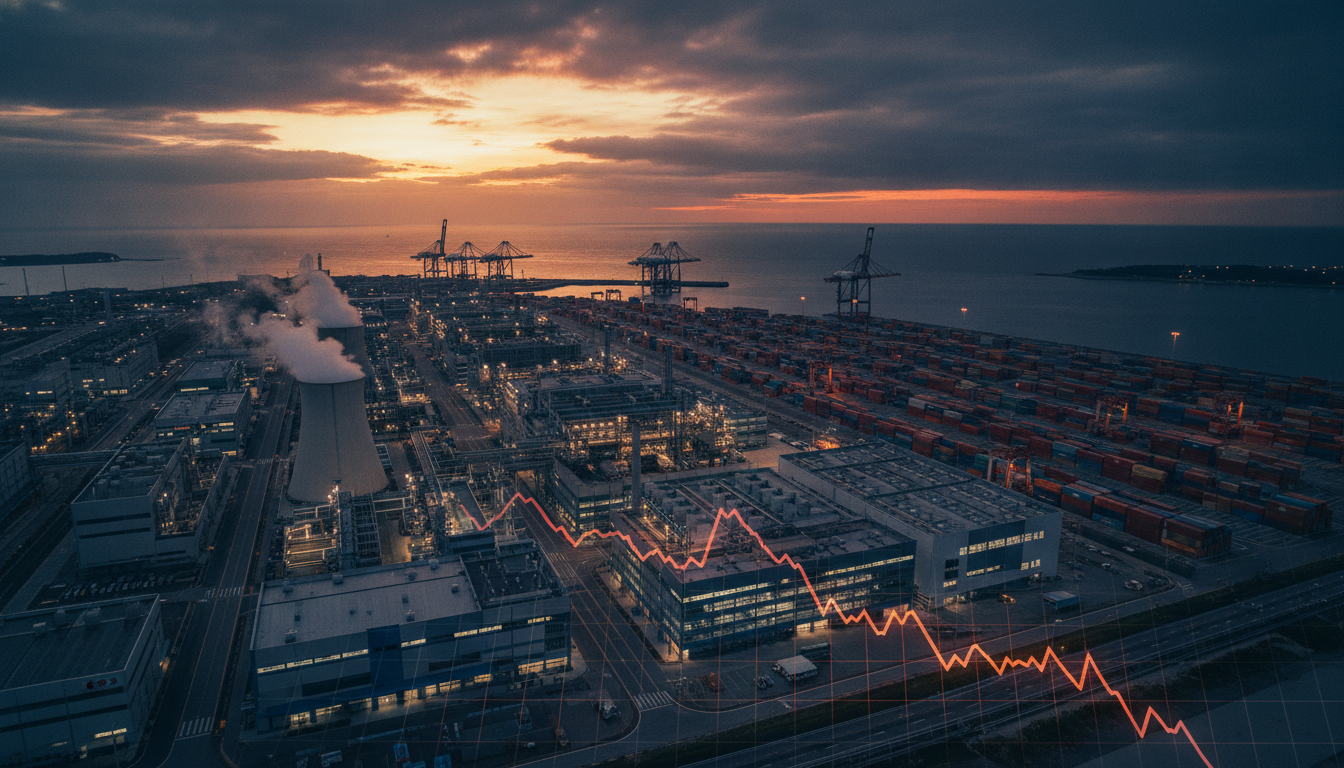
KOSPI’s 5% Drop Exposes Korea’s Semiconductor Export Vulnerability

The Setup

Korea’s benchmark equity index, the KOSPI, fell 5.34% in a single session on July 8, closing at 7,656.31 — a jarring divergence from the comparative calm in New York, where the S&P 500 gained 0.48% to 7,518.88 and the NASDAQ added 0.52% to reach 25,968.15. The CBOE VIX finished at 15.6, barely changed, confirming that US options markets are not pricing anything resembling systemic distress.

That gap between Seoul and New York is the first puzzle. The second is the currency: the USD/KRW pair fell to 1,512.93 — a decline of 1.18% on the day — meaning the Korean won actually appreciated against the dollar at the same moment Korean equities were shedding more than one-twentieth of their value. In a straightforward capital-flight episode, both domestic equities and the currency tend to fall together. The fact that they moved in opposite directions suggests a more nuanced story beneath the headline index move.

Drivers Behind the Move

Korean equities occupy a distinctive structural position in global markets: they function as one of the most direct expressions of the global semiconductor and technology export cycle. Samsung Electronics and SK Hynix together represent a substantial share of KOSPI market capitalization, and their fortunes track memory chip pricing dynamics, enterprise data-center spending, and Chinese end-demand with a sensitivity that few other major markets can match. When any of those variables wobbles, the amplification through the KOSPI tends to be disproportionate relative to developed-market peers.

Into this backdrop arrived a supply-chain subplot worth tracking. As reported by Reuters and Al Jazeera, the United States has imposed sanctions on Rwandan companies it says helped finance armed groups through the illicit minerals trade in eastern Democratic Republic of Congo. According to US Geological Survey mineral commodity data, the DRC is a significant global source of tantalum — extracted from coltan ore — along with tin and tungsten, all of which flow into the electronics supply chain, including capacitor manufacturing and semiconductor packaging materials. The precise impact on Korean manufacturers’ sourcing costs remains to be quantified, but policy-driven disruptions to upstream mineral supply have historically introduced margin uncertainty for assembly-intensive exporters downstream. Markets appear to be pricing at least some probability of that uncertainty materializing.

There is also the broader macro texture. With the US 10-year Treasury yield at 4.52% — up 4 basis points on the day — the cost of capital remains elevated globally, which historically weighs on the capital-expenditure cycles that sustain memory chip demand. If enterprise investment in servers and AI infrastructure were to slow even modestly from its current pace, Korean memory producers would likely register that deceleration before most of their developed-market peers.

What the Bond, FX, and Commodity Markets Are Saying

The fixed-income market is not alarmed. A 4-basis-point rise in the US 10-year to 4.52% sits well within normal daily variation. There was no flight to the safety of longer-duration Treasuries, no compression of yields — the signature moves that accompany genuine risk-off events. Taken at face value, the bond market is saying this is a local Korean equity story, not a global contagion event.

WTI crude oil rising 2.74% to $70.43 carries a specific implication for Korea that it does not carry for most other equity markets. Korea has virtually no domestic hydrocarbon production and is one of the world’s larger per-capita energy importers. Rising oil functions as a dual headwind: it compresses margins in energy-intensive KOSPI sectors — petrochemicals, shipping, steel — while adding to household energy costs that weigh on domestic consumption. The won’s appreciation against the dollar provides a partial natural hedge, since Korean companies pay for oil in dollars and a stronger won cheapens that bill, but the degree of offset depends on the velocity and persistence of both moves.

Gold at $4,156.10, essentially unchanged on the day, reinforces the non-systemic reading. Safe-haven demand is absent. Investors globally are watching Korea, not running from everything at once.

The won’s behavior deserves its own attention. A currency that strengthens while domestic equities fall sharply is unusual but interpretable. One reading: foreign investors may be selling Korean equities on a currency-hedged basis, which creates net won-buying flows in the FX market even as the underlying shares are liquidated. Another is that Korea’s persistent current-account surplus is providing a structural floor beneath the currency even as equity sentiment deteriorates. If the latter dynamic is dominant, it would suggest the KRW move is not a signal that KOSPI has found its bottom, but rather a separate development driven by trade balance mechanics — the two things can move independently for extended periods.

Where Consensus Could Be Wrong

The standard split after a 5%-plus single-day index move is predictable: one camp reaches for the overshooting narrative and a near-term technical bounce, the other reads it as the leading edge of a deeper semiconductor cycle turn. The bull case rests on the AI-driven infrastructure buildout remaining intact — Korean memory producers have been widely covered in semiconductor trade press as central to the high-bandwidth memory segment serving next-generation AI chip architectures, a positioning that was still registering strong order momentum through the first half of the year.

Where that consensus could fracture is on cycle timing. The Q4 2018 KOSPI selloff offers a useful, if imperfect, historical lens. During that period, Korea’s equity market was among the worst performers globally as the prior semiconductor upcycle crested, US-China trade friction escalated, and Korean exporters found themselves squeezed between slowing Chinese end-demand and elevated global uncertainty. The essential dynamic — Korea as a high-beta proxy on an inflecting global technology export cycle — is genuinely analogous to what today’s price action suggests. The critical distinction is that in Q4 2018, US markets were also falling hard; the selloff had an unmistakably global character. Today, US indices are modestly positive and VIX is subdued, which makes the Seoul-New York divergence more pronounced. Historically, such divergences between Korea and the US have tended to close within weeks rather than months, though the direction of resolution varies.

The minerals sanctions add a dimension absent from the 2018 episode: a potential input-cost pressure overlaid on what has been primarily a demand-side debate. If secondary sanctions effects or export-licensing constraints cascade further through the DRC supply chain — as reported by Reuters and Al Jazeera — the narrative for Korean electronics manufacturers could evolve from a single-session market reaction into a multi-quarter earnings story. That scenario appears largely absent from a one-day price move.

Three Weeks of Whiplash: How KOSPI Decoupled

July 8’s plunge did not arrive in isolation. It capped a three-week stretch in which the KOSPI repeatedly detached from US benchmarks — in both directions — and each swing exposed a different facet of Korea’s structural position. On June 17, the index surged 2.92% to 8,795.7 on what read as deliberate capital repositioning around Chinese demand expectations, with the won barely moving. Nine days later, on June 26, came an extraordinary 8.86% single-session gain to 8,930.3 — a move of crisis-reversal magnitude — even as the S&P 500 slipped and the Nasdaq fell 0.87%. Tellingly, the won softened that day (USD/KRW up 0.49% to 1,542.72) and the VIX rose, a combination consistent with foreign institutions selling into domestic strength and repatriating proceeds rather than a durable foreign re-entry.

The reversal began almost immediately. On June 29, the KOSPI fell 0.71% on a session where the VIX itself declined 2.54% — a quiet repricing of China-linked earnings risk rather than global fear, with China’s multi-year property deleveraging suppressing the industrial demand signals Korean exporters depend on. On July 2 the gap widened into a sector story: the KOSPI dropped 1.09% while the NASDAQ jumped 1.23%, US capital chasing AI software and hardware without lifting the Korean and Taiwanese fabs that supply the memory underneath it, as the won slid toward 1,550 — levels that have historically shifted the Bank of Korea’s tone. Then on July 5 the index fell 2.59% against a nearly flat S&P 500, while gold spiked 2.93% and the won, paradoxically, strengthened.

What the Sequence Reveals

Read together, the swings sketch a consistent picture: Korea trades as a high-beta, real-time referendum on Chinese demand and the memory-chip cycle, and the currency has stopped confirming the equity tape. Three times in this stretch — June 26, July 5, and July 8 — the won and the KOSPI moved in opposite directions, pointing to hedged foreign selling and current-account mechanics rather than classic capital flight. That distinguishes this episode from the 2015 devaluation shock, when equities and the won fell together. The China property drag, the AI-capex concentration in US names rather than upstream memory suppliers, and won levels testing BOK comfort zones were all visible before July 8; the 5.34% drop compressed those accumulated pressures into a single session rather than introducing new ones.

Positioning Considerations

For investors carrying Korean equity exposure — through dedicated EM Asia vehicles, global semiconductor funds, or direct KOSPI instruments — the most informative near-term signal is not the price level itself but the trajectory of forward earnings estimates for the index’s major components. A sharp price decline unaccompanied by analyst estimate cuts tends to be a sentiment-driven event with potential for recovery; a decline followed by sustained downward estimate revisions tends to reflect a genuine fundamental inflection. Tracking which pattern develops over the coming two to four weeks offers a cleaner read on the setup than the index level alone.

If growth data from Korea’s primary export destinations were to soften further in the months ahead, history suggests that export-cycle-sensitive markets like Korea tend to see earnings revision cycles accelerate and deepen faster than developed-market benchmarks. Investors with semiconductor supply-chain exposure across their broader portfolio might consider how that exposure behaves under a scenario where both demand softness and input-cost pressure emerge simultaneously — the combination that today’s data configuration is beginning to sketch.

Currency positioning is not incidental to the return calculation. Investors in unhedged Korean equity vehicles would find continued KRW appreciation working in their favor on the FX translation line, partially cushioning equity drawdowns in home-currency terms. Hedged vehicles miss that offset entirely. The current USD/KRW level and its direction therefore have direct bearing on total-return arithmetic for foreign holders of Korean assets, and the two variables — equity and currency — are not moving in tandem today.

For income-oriented investors with Korean corporate bond exposure, the combination of rising energy import costs and elevated equity-market volatility affecting the same issuers is worth reviewing within a credit context. The margin-compression dynamics introduced by both the oil move and the currency cross are relevant to how Korean industrial and petrochemical credits service debt in a scenario where revenue growth disappoints alongside rising input costs.

Editor’s note: this article consolidates our June–July 2026 coverage of the KOSPI’s divergence from US benchmarks.


Sources

  • Reuters / Al Jazeera — ‘How conflict minerals fuel war in eastern DR Congo amid US sanctions’ (https://www.aljazeera.com/video/newsfeed/2026/7/7/how-conflict-minerals-fuel-war-in-eastern-dr-congo-amid-us-sanctions)
  • US Geological Survey — Mineral Commodity Summaries (tantalum, tin, tungsten supply data)
Written by

James Yoo

James Yoo is the editor of Global Invest Daily. He follows global macro and cross-asset markets daily — Federal Reserve and ECB policy, Middle East energy dynamics, China and emerging markets — and writes scenario-based analysis of how geopolitical events transmit into equities, bonds, FX, and commodities. Every post follows the site's editorial standards: in-line attribution for every external statistic, no directive investment advice, and published corrections. Reach him via the site's Contact page.

Leave a Comment