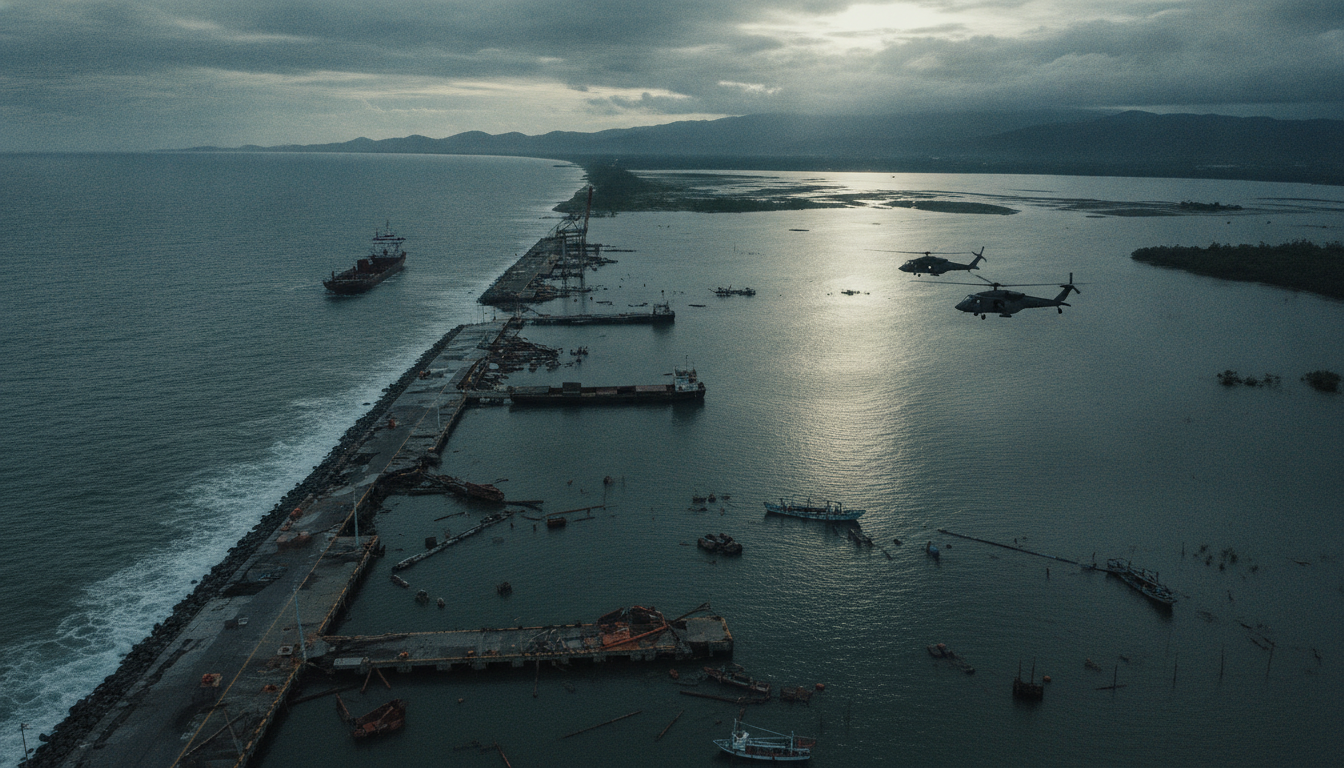
A 7.8 magnitude earthquake killed at least 32 people in Mindanao this morning, and while the human toll dominates headlines, the macro signal is already moving through Asian credit markets and commodity flows. The Philippine peso touched 59.2 per dollar in offshore trading—its weakest level since October 2024—before central bank intervention steadied the rate. This isn’t just a local story: natural disasters in strategically positioned emerging markets force instant repricing of sovereign risk, infrastructure spending capacity, and regional supply chains. For portfolios holding EM debt, Asian equity exposure, or commodity-linked assets, today’s quake is a tangible reminder that geophysical risk sits alongside geopolitical risk in the 2026 macro landscape.
The Macro Picture
The Philippines contributes roughly 0.5% of global GDP, but its role in semiconductor assembly, nickel mining, and Pacific shipping lanes gives it outsized importance in specific value chains. Mindanao alone accounts for about 14% of Philippine economic output and hosts critical infrastructure for agricultural exports—particularly coconut oil and bananas—that feed into broader Asian food commodity markets. The immediate fiscal burden is estimated at $2-4 billion for reconstruction, approximately 0.5% of national GDP, at a time when the Philippine government is already running a 5.8% fiscal deficit and servicing debt at an average yield of 6.2% on 10-year sovereign bonds.
Disaster risk repricing happens fast. Within hours of the quake, credit default swaps on Philippine sovereign debt widened 18 basis points to 142bps, reflecting heightened near-term default probability even though the country maintains investment-grade ratings from two of three major agencies. The pattern is familiar: sudden capital outflows, currency pressure, and a forced choice between defending the exchange rate or preserving fiscal flexibility. Bangko Sentral ng Pilipinas holds $101 billion in foreign reserves—enough to cover 7.2 months of imports—but every dollar spent propping up the peso is a dollar unavailable for post-disaster liquidity support or financial sector stabilization if aftershocks trigger bank runs or insurance payouts.
The broader emerging market context matters enormously right now. With the Fed holding rates at 4.75% and the 10-year Treasury yield climbing 35 basis points today to 4.55%, real yield differentials between US Treasuries and EM debt are compressing. Philippine 10-year bonds yielding 6.2% offer only 165bps of spread over comparable-duration Treasuries, down from 220bps a year ago. A disaster-driven fiscal expansion shrinks that spread further, eroding the carry trade logic that has kept foreign capital flowing into Asian bond markets. When natural disasters collide with a strong-dollar, high-US-rate environment, capital exits fast and returns slowly.
Market Anatomy
Today’s equity selloff—S&P 500 down 2.08%, Nasdaq down 2.99%—had little to do with the Philippines directly, but the disaster amplified an already-nervous tape. The VIX fell 13.02% to 18.71, which sounds counterintuitive given the equity decline, but the drop reflects options hedges rolling off after last week’s Iran-Israel escalation didn’t trigger the feared supply shock. Oil at $90.94 per barrel, up just 0.44%, confirms that geopolitical risk premium is fading while structural supply tightness persists. The 10-year yield jump to 4.55% is the real story: bond markets are pricing slower Fed easing, not faster, despite weaker equity prices. That’s a stagflation signal—growth worries without rate relief.
The Korean KOSPI collapsed 13.37%, a shocking single-day move that reflects both technical deleveraging and fundamental reassessment of regional disaster exposure. South Korea’s economy is deeply intertwined with Southeast Asian supply chains, particularly in electronics and automotive components. A prolonged disruption in Philippine semiconductor assembly plants—several major facilities are located in quake-affected zones—ripples directly into Samsung and SK Hynix production timelines. Currency moves reinforce the stress: USD/KRW fell 0.46% to 1,526, but that masks intraday volatility that saw the won briefly weaken past 1,540 before Bank of Korea verbal intervention steadied flows.
Gold’s 0.10% dip to $4,361 and the dollar’s mixed performance—stronger against emerging market currencies, flat against the yen at 160.16—reveal a market unsure whether to price disaster risk as inflationary (reconstruction spending, supply disruptions) or deflationary (demand destruction, capital flight). The answer depends on policy response speed and scale, but the initial read from credit and currency markets leans deflationary: investors are selling risk assets and hoarding dollars, not bidding up commodities or inflation hedges.
Historical Parallel
The closest analog is the September 2018 magnitude 7.5 earthquake in Sulawesi, Indonesia, which killed over 4,300 people and caused an estimated $2.4 billion in damage—roughly 0.2% of Indonesian GDP. In the two weeks following that quake, the Indonesian rupiah weakened 3.2% against the dollar, sovereign CDS spreads widened 22 basis points, and the Jakarta Composite Index fell 4.1%. Foreign portfolio outflows totaled $1.1 billion in the month after the disaster, and Bank Indonesia was forced to hike rates 25 basis points to 5.75% to stabilize the currency, even as the economy clearly needed easing to support reconstruction.
The key difference today: global rate differentials are far less favorable for emerging markets. In 2018, the Fed funds rate was 2.00-2.25%; today it’s 4.75%. US Treasuries yielded 3.05% in September 2018; today they yield 4.55%. That 150-basis-point difference in the risk-free rate means EM central banks have far less room to cut rates without triggering currency crises, and foreign investors have much less incentive to bottom-fish in beaten-down EM assets when they can earn 4.5% risk-free in dollars. The 2018 playbook—aggressive fiscal stimulus funded by external borrowing at favorable rates—is no longer available. The Philippines will rebuild, but the funding mix will skew more toward domestic resources and multilateral aid, less toward market-based foreign capital, which implies slower recovery and longer-lasting GDP drag.
Portfolio Implications
Equity holders should recognize that today’s disaster amplifies an already-fragile setup for tech hardware and Asia-exposed multinationals. The Nasdaq’s 2.99% drop was led by semiconductor equipment and electronics manufacturing stocks, sectors with meaningful Philippine exposure. Companies like Analog Devices, Texas Instruments, and Qorvo rely on Philippine facilities for back-end assembly and testing. If infrastructure damage forces extended shutdowns, lead times stretch and costs rise, pressuring margins in an environment where tech multiples are already elevated. Watch the PHLX Semiconductor Index: a break below 5,800 would signal that supply-chain risk is being priced more aggressively. Regionally, avoid broad EM equity ETFs with heavy ASEAN weighting until reconstruction timelines clarify.
Fixed income holders face a tricky calculus. Philippine sovereign bonds are likely to underperform, but the disaster risk repricing could spread to other Southeast Asian credits if aftershocks continue or if fiscal cost estimates rise. Indonesia, Vietnam, and Thailand all trade at similar yield spreads to the Philippines and share overlapping investor bases. If foreign funds redeem from regional EM bond funds, selling pressure hits the whole complex. On the US side, today’s 35-basis-point jump in the 10-year yield to 4.55% reflects not just stronger data but also reduced Fed easing expectations. Duration risk is back. If you’re holding long-duration Treasuries expecting rate cuts, today is a reminder that the Fed’s reaction function prioritizes inflation control over growth support. Real yields on 10-year TIPS are now 2.18%, the highest since November 2023, making shorter-duration or inflation-protected bonds more attractive than long-dated nominal paper.
Dollar and currency exposure clearly favor the greenback in the near term. The dollar index didn’t spike today, but EM currency weakness—particularly in Asian currencies with current account vulnerabilities—is the signal. The Philippine peso, Indonesian rupiah, and Thai baht all weakened intraday before central bank interventions. If you hold unhedged international equity or bond exposure, currency drag will offset any local-currency gains. The yen’s stability at 160.16 despite risk-off flows suggests intervention or flow distortions are preventing normal safe-haven appreciation, making the yen a less reliable hedge than usual. For tactical positioning, a modest overweight to the dollar versus EM currencies makes sense until reconstruction funding clarity emerges and capital flight pressures ease.
What to Watch
- Philippine CDS spreads above 160bps: If sovereign credit default swaps widen past 160 basis points, it signals market concern that fiscal costs are exceeding government capacity without IMF or multilateral support. That threshold would likely trigger broader EM credit selloffs.
- US 10-year yield breaking 4.70%: A sustained move above 4.70% would represent the highest yield since early 2024 and would force a major repricing of equity valuations, particularly for growth and tech stocks trading at high multiples. It would also intensify pressure on EM borrowers rolling over dollar-denominated debt.
- Korean won breaching 1,550 per dollar: The KOSPI’s 13.37% collapse today is extreme even by crisis standards. If the won weakens past 1,550, it would indicate that markets are pricing systemic risk in Korean financials or corporates with heavy ASEAN exposure, which would have implications for the broader Asian equity complex.
The Bottom Line
Disasters don’t cause bear markets, but they expose fragility in systems already under stress. The Philippine earthquake hits at a moment when emerging markets are squeezed by high US rates, strong dollar dynamics, and compressed yield spreads that leave little margin for error. For portfolios, the immediate risk is not the Philippines itself but the repricing wave that moves through EM credit, Asian supply chains, and tech hardware stocks dependent on regional manufacturing. The historical lesson is clear: disasters in strategically positioned small economies trigger capital flight that takes months to reverse, and in a 4.5% Treasury yield world, that reversal happens slower and less completely than in past cycles. If you’re holding broad EM exposure or unhedged Asia-focused equity funds, today is a good day to reassess whether the carry and growth premiums justify the geophysical and geopolitical risks you’re actually taking.
