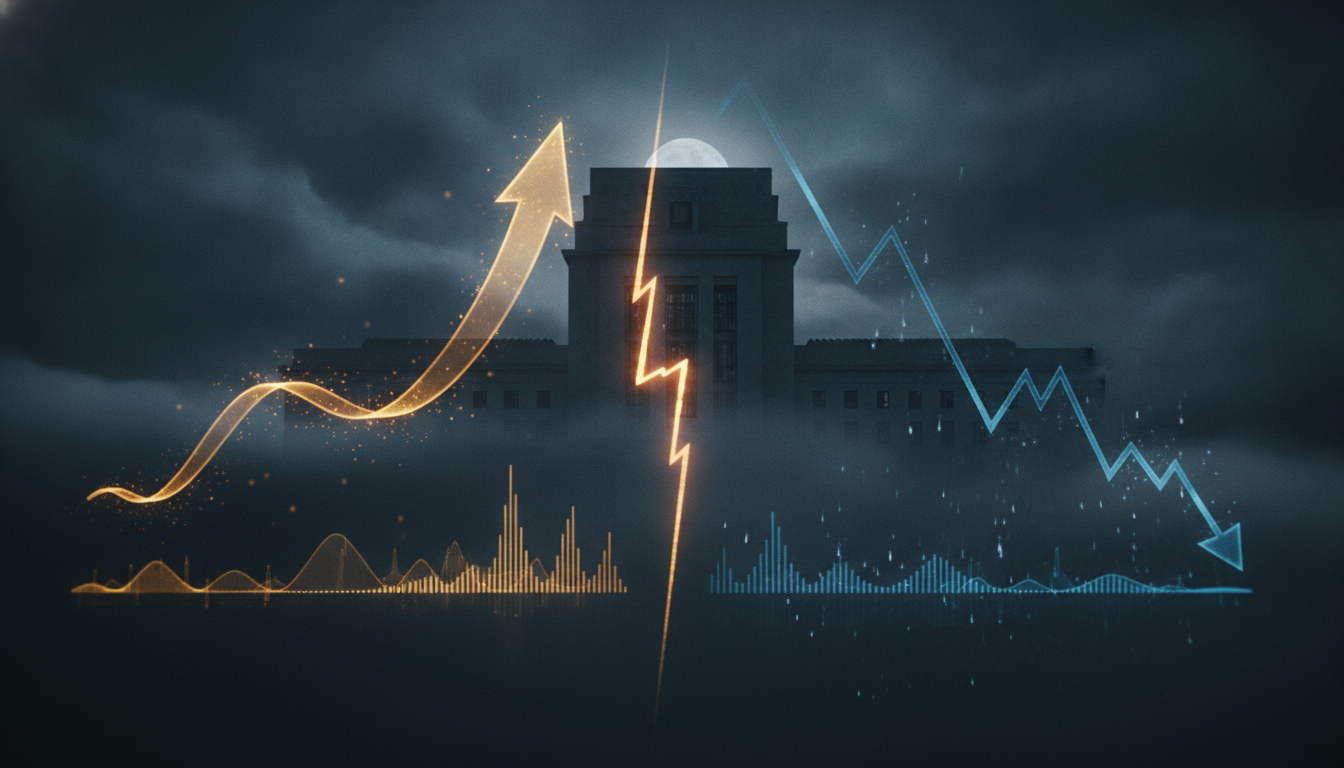
Gold at $4,091, Oil Tumbles 3.6%: Reading the Fed’s Mixed Signals

What Happened

Friday closed with asset classes pulling in sharply different directions. Gold rose 1.51% to $4,091.20 per troy ounce — a level that marks an extraordinary revaluation of the metal relative to its long-run history. At the same time, West Texas Intermediate crude fell 3.59% to $69.34 a barrel, a single-session move large enough to shift the near-term inflation narrative on its own. Equities sat in the middle: the S&P 500 edged up 0.1% to 7,365.4, while the Nasdaq slid 0.42% to 25,369.78. The 10-year Treasury yield dipped 1 basis point to 4.38%, the VIX settled at 18.8, and dollar-yen held at 161.77, essentially unchanged.

Away from the screens, New York City enacted a freeze on rents for approximately one million regulated apartments, per reporting from Reuters and Al Jazeera, fulfilling a core campaign commitment from Mayor Zohran Mamdani. The policy lands at a moment when shelter costs are among the most carefully watched components of the Federal Reserve's preferred inflation gauges.

Why It Matters Now

The Fed's next move hinges on a tension that has proved stubborn: energy and goods prices have retreated meaningfully over the past year, while services inflation — led by housing — has been slower to give ground. Oil's 3.59% drop is the kind of move that mechanically reduces headline CPI pressure over the months ahead. Cheaper crude feeds through to gasoline, transportation, and manufacturing inputs, all of which carry deflationary downstream effects.

The NYC rent freeze operates differently. According to the Bureau of Labor Statistics, shelter is the single largest category within the Consumer Price Index basket, and the BLS derives its shelter measures from actual rent transactions. A freeze on regulated units in New York means a subset of those transactions will report no increase for the coming year. The national effect on measured inflation will depend on how broadly similar policies spread and how quickly lease cycles rotate through the BLS survey — but the political signal may matter as much as the near-term arithmetic: major urban markets are treating housing affordability as an emergency, which places a ceiling on how aggressively rents can move even in unregulated stock.

The Cross-Asset Read

The divergence between gold and oil is the session's most analytically revealing feature. When both rise together, the conventional interpretation is straightforward inflation concern. When gold climbs while oil falls, the message is less tidy — and in some respects more instructive about underlying investor anxiety.

Gold at $4,091 suggests markets are pricing in some combination of: persistent uncertainty about whether the Fed can return inflation to target without triggering a material growth slowdown; concern about the trajectory of U.S. fiscal deficits and the ongoing supply of Treasury debt; and residual geopolitical risk, including the fragile situation in southern Lebanon, where Hezbollah has publicly demanded unconditional Israeli withdrawal per Al Jazeera reporting. Oil's decline, meanwhile, implies either that demand is softening faster than expected, or that supply from key producers is overcoming prior restraint — neither reading is particularly constructive for the growth outlook.

The 10-year yield at 4.38% — down only 1 basis point — tells its own story: the bond market is not yet pricing aggressive Fed easing. The dollar-yen rate at 161.77, unchanged on the day, underscores the same point. The interest rate differential between the U.S. and Japan remains wide enough to keep yen weakness structurally entrenched until either the Fed moves substantially or the Bank of Japan accelerates its own normalization. KOSPI fell 0.71% to 8,411.21, while the Korean won strengthened modestly against the dollar to 1,535.17 — a mixed picture for emerging Asia that reflects global demand uncertainty rather than a clean directional signal.

The VIX at 18.8, marginally lower on the day, suggests the options market is neither panicking nor complacent. This is an environment of managed unease — elevated enough to support hedging demand, not elevated enough to force broad liquidation.

Risks to This View

The constructive scenario holds that oil's 3.59% drop is primarily a supply story — additional barrels reaching market from non-OPEC producers — rather than a signal of demand weakness. In that case, lower energy costs accelerate progress toward 2% inflation, give the Fed the cover to ease from its current stance, and allow the 10-year yield to drift below 4.38%. Gold's elevation becomes a geopolitical hedge rather than a statement about structural economic fragility, and equities have room to re-rate higher on rate relief. The VIX at 18.8 would then look like a buying opportunity rather than a warning.

The more cautious scenario reads oil's single-session decline as an early demand signal: industrial activity slowing, consumer spending fraying, or both. In that case, the Fed faces a difficult configuration — inflation still sticky in shelter, growth softening in goods-sensitive industries. Gold at $4,091 would then reflect something more structural: eroding confidence in fiscal sustainability, a weaker dollar over the medium term, and accumulated distrust of a policy framework that has repeatedly revised its own timelines.

The 2022 inflation shock and tightening cycle is the most fitting historical reference here. When the Fed pivoted from characterizing inflation as transitory to executing one of the sharpest rate-hike campaigns in recent decades, markets experienced precisely this kind of cross-asset confusion — gold volatile, energy prices swinging dramatically, equities whipsawing as investors tried to price an uncertain endpoint. The lesson from that period is that early reads on the Fed's direction proved unreliable guides, and it took well over a year for the distributional effects across asset classes to settle. The confusion itself, not any particular market level, was the feature that repeated. Investors anchoring today's signals to that analog would be cautious about treating any single session's moves as conclusive.

Portfolio Angle

For investors managing diversified portfolios, the current configuration rewards scenario-based thinking over single directional conviction.

  • If energy prices continue to ease and the next PCE print shows genuine progress on goods deflation, history suggests longer-duration fixed income has tended to perform well in similar environments — particularly when nominal yields are as elevated as the current 4.38% on the 10-year and real rates have room to compress as inflation expectations fall.
  • If shelter inflation proves as persistent as the NYC rent situation implies — where policy constrains the upside but does not produce actual measured declines — the Fed's timeline for easing could extend further than current yield levels suggest. In that scenario, rate-sensitive equity sectors, including the technology names that drove Nasdaq underperformance Friday, could continue to face headwinds.
  • Gold's positioning at $4,091 is consistent with its historical role as a portfolio diversifier during periods when both the inflation trajectory and the growth outlook are genuinely unresolved. Investors who approach it as a tail-risk hedge rather than a return-generating trade may find the current environment more legible than those treating it as a pure bet on rate cuts.
  • The Nasdaq's 0.42% underperformance relative to the broader S&P 500 reflects the ongoing sensitivity of longer-duration growth assets to a 4.38% 10-year yield. If rates remain anchored near current levels through the next round of data, that intra-equity spread between growth and value-oriented sectors may persist.

Three Things to Watch

  • PCE and CPI shelter sub-index prints: The next round of inflation data will show whether oil's decline is pulling headline numbers lower fast enough to compensate for sticky rent and services costs. That is the core question the Fed is trying to answer, and the data will determine whether a 4.38% 10-year yield still reflects fair value.
  • Fed communication and FOMC minutes: Any signals from officials about whether current data meets their threshold for action will sharply reprice both the bond market and rate-sensitive equities. The 10-year at 4.38% implies the market is not yet convinced a cut is imminent; a shift in tone could move that quickly.
  • WTI's follow-through: A single-session 3.59% decline could be noise or the beginning of a trend. If crude settles durably below $70, the inflation math changes substantially — and so does the fundamental case for gold remaining at $4,091, which partly reflects the same uncertainty that keeps oil traders cautious.

Sources

  • Reuters / Al Jazeera — NYC rent freeze coverage, June 26, 2026 (aljazeera.com)
  • Al Jazeera — Hezbollah statement on Israeli withdrawal, June 26, 2026 (aljazeera.com)
  • U.S. Bureau of Labor Statistics — Consumer Price Index methodology and shelter component weighting (bls.gov)
Written by

James Yoo

James Yoo is the editor of Global Invest Daily. He follows global macro and cross-asset markets daily — Federal Reserve and ECB policy, Middle East energy dynamics, China and emerging markets — and writes scenario-based analysis of how geopolitical events transmit into equities, bonds, FX, and commodities. Every post follows the site's editorial standards: in-line attribution for every external statistic, no directive investment advice, and published corrections. Reach him via the site's Contact page.

Leave a Comment